If you've been looking at AI tools to handle leads, answer calls, or book appointments, you've probably noticed the terminology is a mess. AI autoresponder, AI chatbot, AI appointment setter, AI call center. They all sound like the same thing, but they actually do very different jobs.
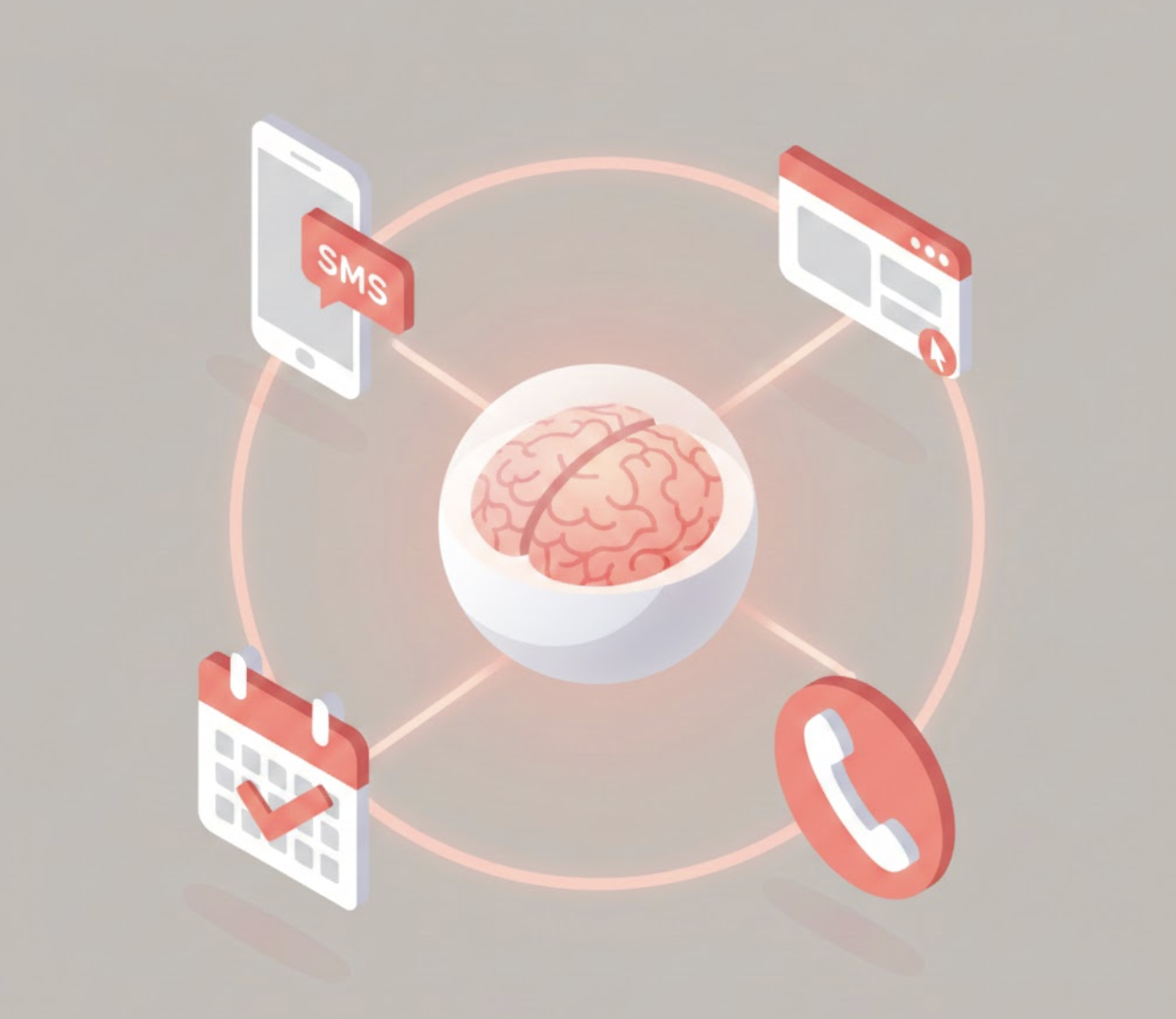
This guide breaks down each category, compares them side by side, and explains why the best AI systems for contractors and home service businesses combine all four into one platform.
What Is an AI Autoresponder?
An AI autoresponder is an automated system that instantly replies to incoming leads via SMS, email, or messaging platforms. No human in the loop. It uses AI to craft contextual, personalized responses and can qualify prospects, answer common questions, and kick off follow-up sequences, all within seconds of first contact.
Unlike a basic auto-reply that blasts the same canned message to everyone, an AI autoresponder actually reads the incoming message, figures out what the prospect needs, and responds accordingly. Here's what that looks like in practice:
Instant SMS response. When a lead texts your business number or submits a form, the AI fires back a personalized reply in under 60 seconds. No templates. No delays. The response addresses what the lead actually asked about.
Email follow-up. The same system can trigger email sequences tailored to the lead's inquiry. An HVAC lead asking about AC installation gets different follow-up than someone asking about duct cleaning.
Lead qualification. The AI doesn't just respond. It asks the right questions. Budget range, timeline, location, scope of work. By the time a human gets involved, the lead is already pre-qualified.
24/7 availability. Leads come in at 11 PM on a Saturday. They come in during your lunch break. They come in while you're on a roof. An AI autoresponder doesn't take breaks, doesn't forget, and doesn't let leads sit unanswered.
Multi-channel coverage. The best AI autoresponders work across SMS, email, web forms, and social media, responding on whatever channel the lead used to reach out.
What Is an AI Chatbot?
An AI chatbot is a conversational interface, typically embedded on a website or messaging platform, that engages visitors in real-time text dialogue. It uses natural language processing to understand questions, provide answers, guide users through processes, and collect information. Think of it as a simulated live conversation with a human rep.
Chatbots have been around for years, but the gap between basic and advanced versions is massive.
Website chat widgets. The most common form. A chat bubble pops up on your website and asks "How can I help?" Basic versions follow rigid scripts. Advanced AI chatbots understand free-form questions and respond naturally.
Facebook Messenger and social chat. AI chatbots can live inside Messenger, Instagram DMs, and other social platforms, meeting leads where they already spend time.
Conversational AI vs. scripted bots. This is the key distinction. A scripted chatbot follows a decision tree: if the user says X, respond with Y. A conversational AI chatbot understands intent, handles unexpected questions, and adapts on the fly. For contractors and home service businesses, the difference is night and day.
Limitations. Even advanced chatbots are limited to the channel they live on. A website chatbot can't follow up via SMS the next day. It can't call a prospect. It handles the conversation happening right now, in that moment, on that platform. That's it.
What Is an AI Appointment Setter?
An AI appointment setter is a system that autonomously books meetings and service appointments by interacting with leads, checking calendar availability, confirming scheduling details, and sending reminders. Less manual coordination, fewer no-shows.
If the goal of an autoresponder is to engage the lead and the goal of a chatbot is to have a conversation, the goal of an appointment setter is to get something on the calendar.
Calendar integration. The AI connects to your scheduling system (Google Calendar, Calendly, ServiceTitan, Housecall Pro, whatever you use), sees real-time availability, and books directly.
Qualification before booking. Smart AI appointment setters don't just book anyone. They confirm the lead is in your service area, needs a service you offer, and fits your basic criteria before locking in a time slot.
Automated confirmations and reminders. Once booked, the system sends confirmation texts and emails, then follows up with reminders as the appointment approaches. This alone can cut no-shows significantly.
Reducing no-shows. No-shows are a contractor's worst enemy. An AI appointment setter can send day-before reminders, morning-of confirmations, and even reschedule automatically if the customer needs to move the appointment. All without you touching your phone.
What Is an AI Call Center?
An AI call center uses voice AI to answer inbound phone calls, interact with callers using natural-sounding speech, route calls based on urgency or intent, and handle common inquiries. It functions as an automated receptionist or phone-based support team, available around the clock.
This is the category that's evolving fastest. Voice AI has gotten remarkably good, and for many routine calls, callers genuinely can't tell the difference.
AI that answers phone calls. When a customer calls your business, the AI picks up, greets them naturally, and handles the conversation. It can answer FAQs, take messages, and gather information.
Call routing. Not every call should go to voicemail or get the same treatment. An AI call center can route emergency calls differently than general inquiries, send sales leads to one place and support questions to another.
24/7 answering. The biggest pain point for contractors: missing calls after hours, on weekends, and during jobs. An AI answering service covers every hour of every day.
Replacing or assisting human receptionists. An AI call center doesn't have to replace your front desk entirely. Many businesses use it as a first layer. The AI handles routine calls and only escalates complex situations to a human.
AI Autoresponder vs. AI Chatbot vs. AI Appointment Setter vs. AI Call Center
Here's how these four categories compare at a glance:
| Feature | AI Autoresponder | AI Chatbot | AI Appointment Setter | AI Call Center |
|---|---|---|---|---|
| Primary channel | SMS, email | Website, social chat | Calendar / scheduling | Phone calls |
| Response time | Under 60 seconds | Instant (on-site) | Varies | Instant (answers call) |
| Lead qualification | Yes | Basic to advanced | Yes (pre-booking) | Limited |
| Appointment booking | Can trigger | Rarely | Core function | Can transfer |
| 24/7 coverage | Yes | Yes | Yes | Yes |
| Multi-channel | Yes | Single channel | Single channel | Phone only |
| Follow-up sequences | Yes | No | Reminders only | No |
| Handles missed calls | Yes (text-back) | No | No | Yes |
| Best for | Lead response speed | Website engagement | Booking efficiency | Phone coverage |
Why businesses confuse these. The terminology overlaps constantly. A company selling an "AI chatbot" might also book appointments. An "AI call center" might send follow-up texts. The labels describe the primary function, but the lines blur in practice.
Why modern AI systems combine all four. The most effective platforms don't force you to choose. They respond instantly via text, qualify leads through conversation, book appointments on your calendar, and hand off to a person when a prospect is ready to talk. The better platforms go further still, recognising when a lead is actually ready to move and acting on that moment rather than treating every lead the same.
The real question isn't "which one do I need?" It's whether your system handles the full lifecycle, from first contact to booked appointment.
Why Businesses Need More Than a Basic Chatbot
A chatbot on your website is a start. But for contractors and home service businesses buying leads from Yelp, Google Local Services, Meta ads, and other platforms, a chatbot alone leaves massive gaps.
Slow follow-up kills deals. Studies consistently show that responding to a lead within the first minute increases conversion rates dramatically. After five minutes, your odds drop by 80%. After 30 minutes, that lead has already called your competitor.
Contractors miss 30-50% of calls. You're on a job site. You're driving. You're on another call. It doesn't matter why you missed it. The lead doesn't wait. For HVAC contractors in the middle of summer or roofers after a storm, every missed call is lost revenue.
Paid leads demand speed. When you're paying $30-$100+ per lead from Yelp, Google, or Meta, letting that lead sit unanswered for even 10 minutes is burning money. The math is simple: if you're buying 100 leads a month and only connecting with 60% because of slow follow-up, you're wasting 40 leads. At $50 each, that's $2,000 a month thrown away.
Humans can't consistently reply in under 60 seconds. Even the most dedicated office manager can't respond to every lead within a minute, every time, across every channel, 24 hours a day. It's not a people problem. It's a physics problem. AI solves it.
Real example. A plumbing company running Google Local Services ads gets a lead at 8:47 PM on a Wednesday. The office is closed. Without AI, that lead gets a voicemail and maybe a callback the next morning, if someone remembers. With an AI autoresponder, the lead gets a personalized text in 30 seconds, answers two qualification questions, and has an appointment on the calendar before 9 PM. That's the difference between a $300 job booked and a lead lost to the next plumber in the search results.
What a Modern AI Lead Response System Looks Like
The most effective AI systems for contractors and home service businesses aren't just autoresponders or chatbots or appointment setters. They're integrated platforms that handle the entire lead-to-appointment pipeline:
Instant SMS response. Lead comes in from any source (Yelp, Google, Meta, your website, a missed call) and gets a personalized text reply within seconds.
Intelligent email follow-up. Automated email sequences that adapt based on the lead's responses, service needs, and engagement level.
AI-powered qualification. The system asks the right questions to determine if the lead is a good fit (service needed, location, timeline, budget) before a human ever gets involved.
Knowing when to escalate. Recognising that a lead is qualified and ready to move forward, and handing it to your team at that moment rather than on a fixed schedule. This is what separates a system that replies quickly from one that actually converts.
Appointment booking. Direct calendar integration that lets the AI book appointments, send confirmations, and handle rescheduling.
CRM logging. Every interaction (texts, emails, calls, appointments) gets logged automatically. No manual data entry. Full visibility into your pipeline.
Missed call follow-up. When you can't answer a call, the AI immediately texts the caller, starts a conversation, and works toward booking. A missed call becomes a booked job instead of a lost lead.
The focus is always on outcomes: leads responded to, appointments booked, calls connected, revenue captured.
The Bottom Line
If you're looking for an AI autoresponder, AI chatbot, AI appointment setter, or AI call center, the real question isn't which one you need. It's whether your system handles all four.
The businesses winning today aren't choosing between these tools. They're using platforms that combine instant text response, intelligent conversation, automated booking, and live call connection into one system that never misses a lead.
Every missed call, every slow reply, every lead that goes cold is revenue walking out the door. The technology to stop that exists now.